An essential aspect of creativity is not being afraid to fail - Edwin Land
The creative adult is the child who has survived - Ursula Le Guin
5 minds of the future Howard Gardner - Book
Reclaiming youth at risk - Book
Creativity is a natural extension of our ethusiasm - Earl Nightingale
Creativity is merely a plus name for regular activity. Any activity becomes creative when the doer cares about doing it right, or better - John Updike
Sunday, May 6, 2012


Friday, May 4, 2012
Calculus Speed trap
Catching speeders from our math class
Instead of using a worksheet, or pseudo-context question
from a textbook you can show how related rates can be used to estimate the
speed of a car from our classroom window.
1)
I used the Distmeasure app to determine the
distance my classroom window is from the road.

2)
A student extended his arm and followed a car
with arm until it hit a 45 degree angle.
Different students timed how long it took and we averaged the
times. [This will allow us to calculate
the average rate of change of his arm in radians/second] in our class this took
4.6 seconds, as the following:

3)
Perform the calculations below

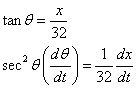
Since we know that student stopped at 45 degrees we can use the special triangle of 45/45/90 to substitute into the above formula.
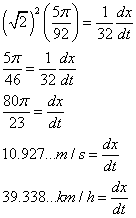
4)
Talk about the limitations of this activity, and
how accurate this is.
Wednesday, May 2, 2012
Changing Assessment Presentation
I am putting on a session called "Globablization of Assessment" Below is my presentation and talking points:
My Talking points:
My Talking points:
Math teachers indicated that they rely on a textbook for
more than 80% of their teaching and most math teachers (at least 60%) reported
that their instruction is quite similar to textbook tests. – Center for the
study of testing, evaluation, and education policy.
Mayor of New Jersey strongly backed the pedagogical approach
of using “constant drill and repetition” and even said “It is not that hard to
give answers if someone just told you what to say. They memorize back and know and get used to a
lot of A’s on quizzes” But when asked if
he would send his own children to this type of school, he answered “no, those
schools are best only for certain children”.
Imagine the difference between your child running home and
saying “I had a great day because I got an A, got the highest mark in the
class, won the math challenge” or saying “I know understand how to reduce
fractions, multiply two digit numbers, or argue critically”. One is saying learning is a means while the
other is regarding learning as an end.
Research has shown that an overemphasis on achievement:
1)
Undermines students interest in learning
2)
Makes failure overwhelming
3)
Leads students to avoid challenging themselves
4)
Reduces the quality of learning
5)
Invites students to think about how smart they
are instead of how hard they tried.
When we get carried away with results, we wind up,
paradoxically, with results that are less than ideal. Evidence has shown that our ideal long term
goals for our children and students are less likely to become reality when the
education system and its stakeholders become preoccupied with standards and
achievement.
If the point of school is to achieve and demonstrate success
instead of stretch your thinking and be challenged, then it is completely
logical that a child will always take the easiest route; sometimes the
unethical easier route.
501 mothers were questioned and more preferred their
children to complete projects that would involve less struggling but result in
success than those where their children would learn a lot more, struggle
through it, and could potentially make a lot of mistakes. Is this right?
Candle project – rewards slowed down the thinking.
The probability of getting a reward has the same brain
action as someone who is addicted to drugs.
Rewards promote just as much bad behaviour as good ones.
People of different abilities tend to learn more effectively
on a range of tasks when they’re able to cooperate with one another than when
they are trying to defeat one another.
Grades divert attention from education itself and otherwise
prove counterproductive. They also do
not provide accurate and reliable information.
Interesting studies:
When teachers use hands-on interactive learning activities,
students who were not graded at all did just as well on a proficiency exam as
those who were. Students who attended
elementary schools where no grades were used matched a sample of students who
had received traditional report cards for 6 years. 5th graders who were told they
would be graded on how well they remembered the social studies curriculum had
more trouble understanding the main point of the text than did those who were
told no grades will be used. Even on
strict recall the graded group remembered less.
Studies have shown over and over the more creative the task
the worse of the performance of students when grades are used. Only when comments are given, instead of
numerical scores, will the learning increase.
Ruth Butler’s experiment
Tests and grades may make students learn today
but will they may not want to tomorrow
Monday, April 30, 2012
Session: Globalization of Assessment
| On Wednesday, May 2nd, I am speaking, in Spruce Grove Alberta, on the needed change of assessment, below is the title and some information. |
Globalization of AssessmentThe economy has drastically changed and now the education system needs to change how it is preparing students for the world outside the walls of the classroom. Traditional assessment and instructional techniques are preparing students for the traditional world not the current one. Education cannot keep doing what it has always been doing and expect a different outcome.Presented by David Martin Dave has been teaching High School Mathematics for 5 years. He is currently teaching Calculus, but has taught both Junior High and High School Math. Recently, Dave was nominated for Alberta Teacher of Excellence in the field of technology innovation. At one point in time, Dave used worksheets, tests and homework to motivate students to learn math, however, currently he has outlawed all three in his classroom. Dave is currently teaching at Notre Dame High School in Red Deer, Alberta. Dave graduated from the University of Lethbridge with a degree in both Mathematics and Education, and is currently taking his Masters of Mathematics Education through the University of Waterloo. He has spoken at events throughout Alberta, sharing his message of how he is moving away from traditional assessments and towards an approach where he instructs through his assessments and how learning is always the focus. At the Horizon Stage in Spruce GroveWednesday May 2, 2012 7-8:15pmDoors open at 6:45 No ticket required |
Wednesday, April 25, 2012
Math and Super Mario Brothers
Usually I would hand out a worksheet on calculating when a function is closest to a point and have students complete 10-12 questions. This year, I took the a different approach by bringing Super Mario Brothers in my class.
Using this picture,
 I informed my class about Mario Brothers; when you jump, with Yoshi, you can jump again. I then posed the question, "When would be the best time to jump off Yoshi if you want to get to the top level?"
Using Calculus, and geogebra you can calculate the path of Yoshi and the co-ordinate of the top level to get:

From here we calculated the equation of the parabola, and a distance function based on any point (x, f(x)) on the function. Ultimately, we calculated the closest distance Yoshi comes to the point, and when to double jump to get the coin.
Students enjoyed this more than completing the 10 questions on the worksheet. Feel free to use and fix as you see fit.
Using this picture,

Using Calculus, and geogebra you can calculate the path of Yoshi and the co-ordinate of the top level to get:

From here we calculated the equation of the parabola, and a distance function based on any point (x, f(x)) on the function. Ultimately, we calculated the closest distance Yoshi comes to the point, and when to double jump to get the coin.
Students enjoyed this more than completing the 10 questions on the worksheet. Feel free to use and fix as you see fit.
Tuesday, April 24, 2012
Subscribe to:
Posts (Atom)